

The goal of this guide is to provide the Gwent newcomers with cheap decks. The decks were built with an initial budget of 400 scraps. We also included 4 upgrades per faction, tailoring each deck towards the meta standard.
You can join our Discord if you have any questions.
Writing: Wusubi and Hippo
Editing: Sebodunum
Last update: May 25, Patch 8.5

MO is the ideal faction for beginners, as it’s very straightforward but powerful in the right hands. Whether you’re dwarfing the opposing units with towering giants, covering their board in Frost or swarming the battlefield with buffed up Insectoids, these slimy buggers can quickly overpower any opponent.
We’ll be working towards an Arachas Swarm deck with Organic cards. It distributes its points widely instead of investing them into tall units, meaning that opposing tall punish cards aren’t nearly as effective.

Crafting cost: 400 scraps
[200 scraps] Adda: Striga
[200 scraps] Golyat
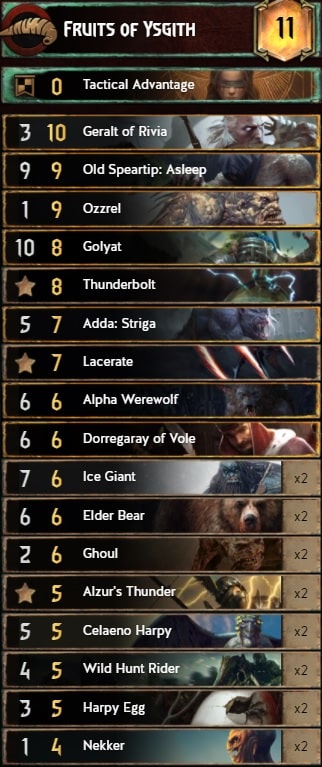
Until we craft some swarm cards, we’ll be relying on Fruits of Ysgith. The additional points from Gernichora’s Fruit help with the game plan of winning Round 1 and pushing Round 2 to force a short Round 3 with Ozzrel.
Since MO usually have Dominance, Adda: Striga is a potent removal tool. When playing Golyat, be mindful of cards like Geralt of Rivia.
Crafting cost: 1160 scraps
[160 scraps] 2x Endrega Larva
[200 scraps] The Beast
[800 scraps] Crimson Curse
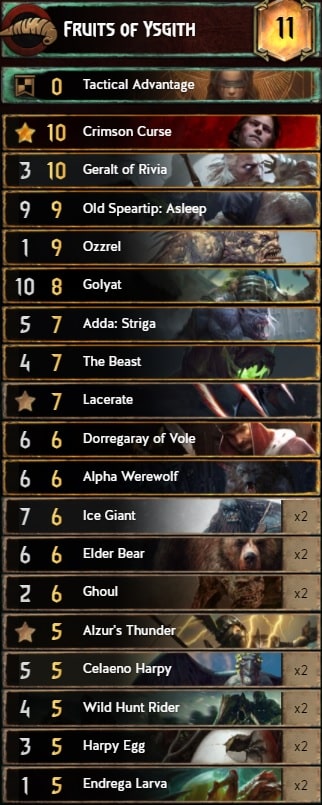
Endrega Larva is harder to remove than Nekkers and The Beast is a nice engine. Crimson Curse represents a lot of points over time, while helping us transition into a swarm-based deck.
Start by upgrading 2x Nekker to 2x Endrega Larva, then replace Alzur’s Thunder with The Beast. And finally, cut Thunderbolt for Crimson Curse.
Crafting cost: 1540 scraps
[320 scraps] 2x Arachas Nest, 2x Spontaneous Evolution, Arachas Behemoth
[800 scraps] Yennefer of Vengerberg
[420 scraps] 2x Bone Talisman, 2x Chimera, Parasite
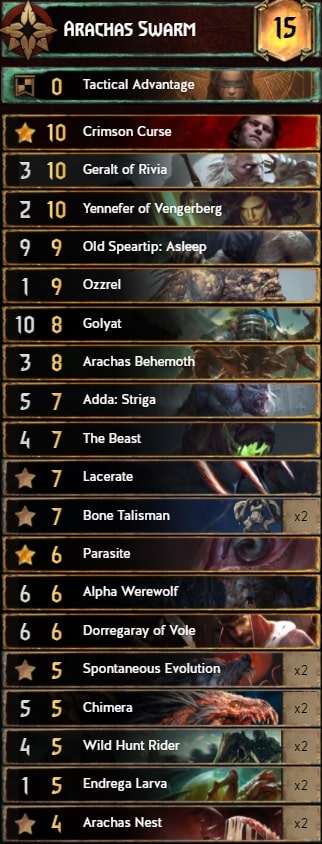
In this upgrade, we’ll be revamping the bronze core. First, we add cards that swarm the board and then some strong pay-offs like Bone Talisman and Yennefer of Vengerberg.
Switch your leader ability to Arachas Swarm, then replace 2x Harpy Egg, 2x Celaeno Harpy and Alzur’s Thunder with 2x Arachas Nest, 2x Spontaneous Evolution and Arachas Behemoth.
Next, upgrade Ghoul to Yennefer of Vengerberg and switch out the other Ghoul, 2x Elder Bear, and 2x Ice Giant for 2x Bone Talisman, 2x Chimera and Parasite.
Crafting cost: 1820 scraps
[800 scraps] Triss: Telekinesis
[800 scraps] Whispess: Tribute
[220 scraps] 2x Endrega Warrior, 2x Endrega Eggs
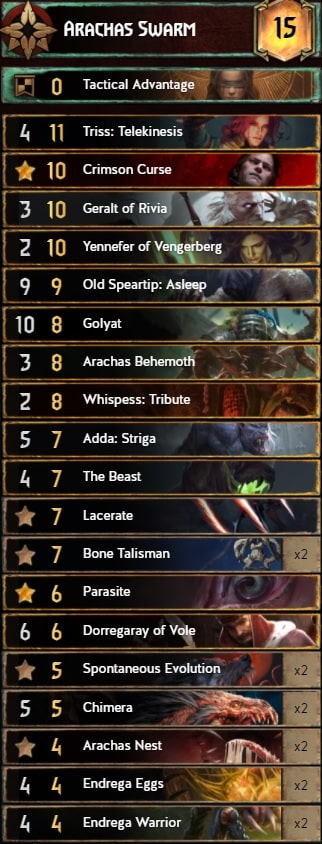
In this upgrade, we’re adding Triss: Telekinesis, who can serve as either an additional swarm pay-off with Bone Talisman or as a swarming tool herself, creating Spontaneous Evolution or Arachas Nest. Whispess: Tribute adds some much-needed consistency to the deck.
Switch out Ozzrel and Alpha Werewolf for Triss: Telekinesis and Endrega Warrior. Next up, you can replace 2x Wild Hunt Rider and 2x Endrega Larva with Whispess: Tribute, 2x Endrega Eggs and another Endrega Warrior.
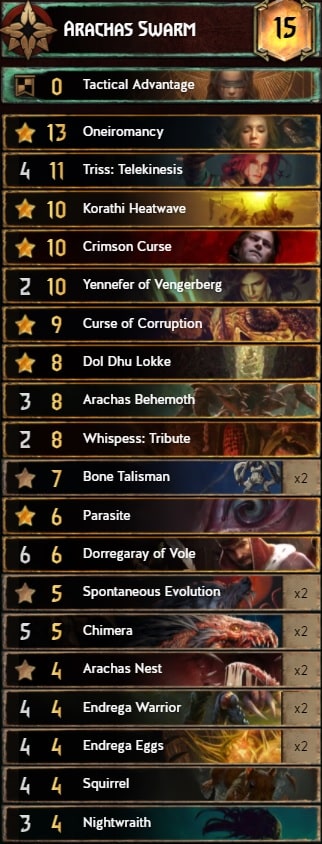
Crafting cost: 2710 scraps
[800 scraps] Oneiromancy
[800 scraps] Korathi Heatwave
[800 scraps] Dol Dhu Lokke
[310 scraps] Curse of Corruption, Squirrel, Nightwraith
For the last upgrade, we’re making the deck more consistent with Oneiromancy while crafting Korathi Heatwave as a powerful control tool. Dol Dhu Lokke allows you to play another Chimera while offering more Drones with its Order ability.
It’s time to part ways with our good pals, Old Speartip: Asleep and Golyat, which grants you the provisions to include Oneiromancy and Squirrel. You can then replace Lacerate and The Beast with Korathi Heatwave and Nightwraith.
Finally, switch out Geralt of Rivia and Adda: Striga for Curse of Corruption and Dol Dhu Lokke. You can save 800 scraps if you unlock Dol Dhu Lokke in your reward book (Viy’s tree).

Having to resort to guerilla warfare, ST grew crafty and resourceful. Swiftly moving across the battlefield, they’re a huge threat to anyone who dares enter their woods.
We’ll be working towards a spell-based Nature’s Gift deck. It has good control options while also slamming a lot of points on your own side of the board. The deck can play similarly to MO by trying to force a short Round 3 with Harald Gord, but its long round potential is nothing to scoff at either thanks to engines like Eithné: Wrath of the Brokilon and Gezras of Leyda.
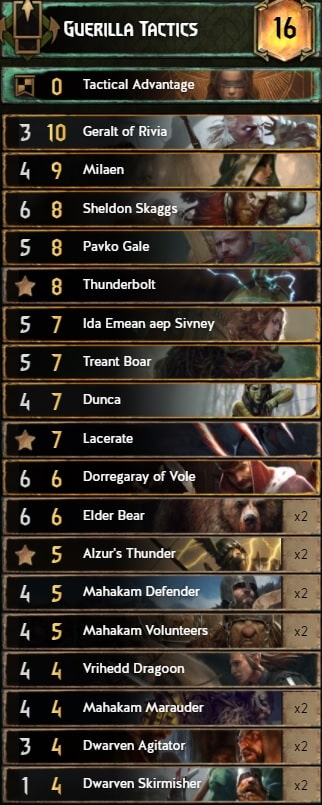
Crafting cost: 400 scraps
[200 scraps] Dunca
[200 scraps] Treant Boar
Dunca is a terrifying engine in Round 1, because she generates carry-over for the future rounds. Treant Boar offers a lot of value in a long round and synergizes with Guerilla Tactics.
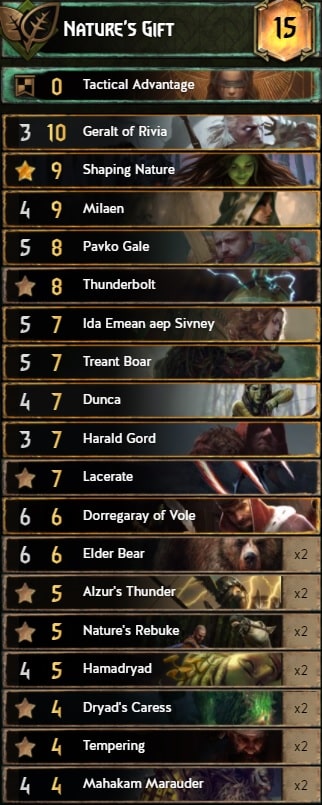
Crafting cost: 1440 scraps
[440 scraps] 2x Hamadryad, 2x Dryad’s Caress, 2x Nature’s Rebuke, 2x Tempering
[800 scraps] Shaping Nature
[200 scraps] Harald Gord
This upgrade might strike you as expensive and complicated, so let’s take it one step at a time.
We’ll be switching the leader to Nature’s Gift. The passive ability will spawn a Wandering Treant each time you play a Nature card and the active ability synergizes with Hamadryad.
Replace Sheldon Skaggs, 2x Mahakam Defender, 2x Dwarven Agitator, 2x Mahakam Volunteers and Dragoon with 2x Hamadryad, 2x Dryad’s Caress, 2x Rebuke and 2x Tempering.
Once you’ve got another 800 scraps, upgrade Dwarven Skirmisher to Shaping Nature. For 200 more scraps, switch out the other Skirmisher for Harald Gord.
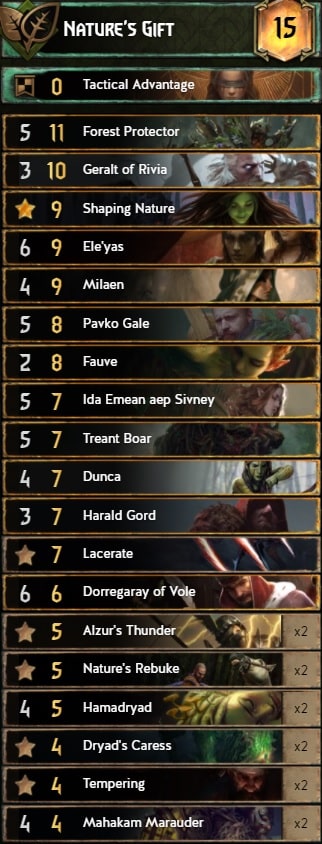
Crafting cost: 1920 scraps
[800 scraps] Fauve
[800 scraps] Forest Protector
[200 scraps] Ele’yas
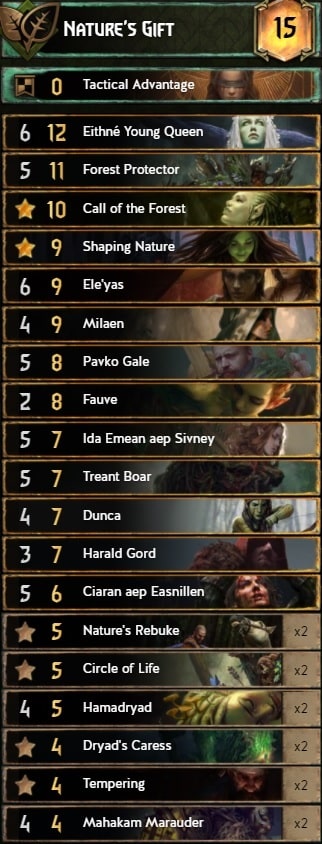
Fauve allows you to tutor a Nature card, with Shaping Nature and Nature’s Rebuke being the optimal targets. Forest Protector is a flexible card that plays for great value, just make sure you have at least one bronze Nature card in your graveyard.
Start by replacing Thunder with Fauve and then switch out an Elder Bear for Forest Protector. Finally, upgrade the other Elder Bear to Ele’yas, who can be used on Wandering Treants.
Crafting cost: 1960 scraps
[800 scraps] Eithné Young Queen
[800 scraps] Call of the Forest
[360 scraps] Ciaran aep Easnillen, 2x Circle of Life
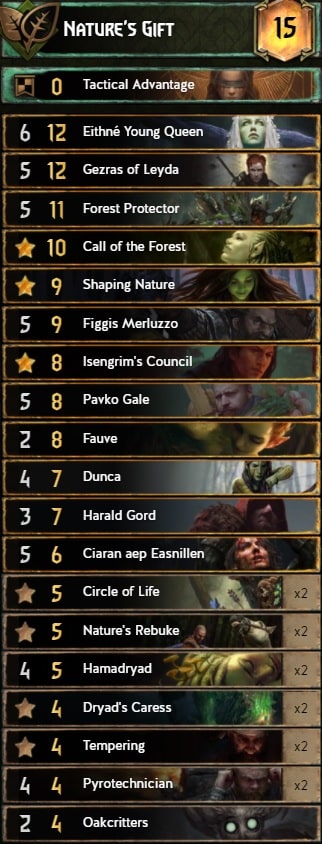
In this upgrade, we get rid of Neutral cards, which allows you to utilize Eithné Young Queen and Pavko Gale to their full potential.
You can save 800 scraps if you buy the ST starter pack with Eithné Young Queen. Get rid of Dorregaray to accommodate her. You can then replace Geralt of Rivia with Call of the Forest, Lacerate with Ciaran and 2x Alzur’s Thunder with 2x Circle of Life.
Crafting cost: 2490 scraps
[800 scraps] Isengrim’s Council
[800 scraps] Figgis Merluzzo
[890 scraps] Gezras of Leyda, Oakcritters, 2x Pyrotechnician
The final upgrade adds Isengrim’s Council for greater consistency and Figgis Merluzzo to offer some protection for the likes of Pavko Gale and Gezras of Leyda.
Switch out Treant Boar for Isengrim’s Council and then replace Milaen with Figgis. At any point, replace 2x Mahakam Marauder with 2x Pyrotechnician. To complete the deck, get rid of Ele’yas and Ida while crafting Gezras and Oakcritters.

NR used to be a slow burn, but after the Way of the Witcher expansion, they’re a roaring flame. Under the mentorship of Vesemir, the Witcher students have quickly become adept at dispatching monsters.
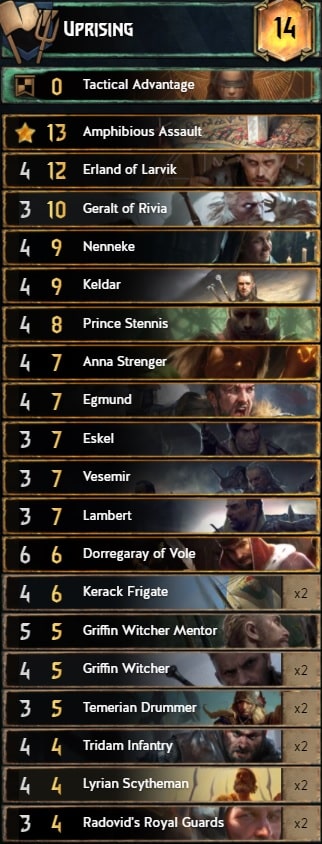
We’ll be working towards an Uprising deck that focuses on establishing carry-over in Round 1 with Erland and Vesemir: Mentor, then leveraging that carry-over into explosive points with the Witcher trio (Eskel, Vesemir, Lambert) and Lyrian Scytheman.
Crafting cost: 520 scraps
[160 scraps] 2x Kerack Frigate
[160 scraps] 2x Radovid’s Royal Guards
[200 scraps] Keldar
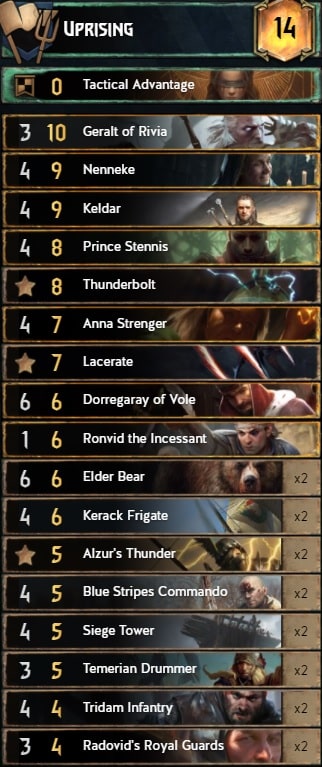
Building NR on a budget can be challenging, as all of the truly impactful cards cost 800 scraps. Therefore, the optimal approach (at least initially) is to craft as many useful engines as possible.
Radovid’s Royal Guards can boost an allied engine by 2 and give it 2 armor, which can come in handy when protecting vulnerable units such as Temerian Drummer or Anna Strenger.
Kerack Frigate synergizes with adjacent soldiers, serving as a 2-points-per-turn engine. Keldar has a similar purpose, with the caveat of having to play him later into the round because of his Adrenaline condition.
Crafting cost: 1060 scraps
[260 scraps] Egmund, 2x Lyrian Scytheman
[800 scraps] Amphibious Assault
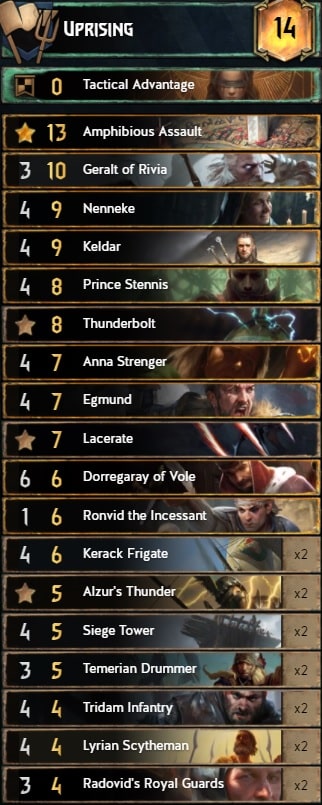
Egmund is another strong engine synergizing with Uprising, while Amphibious Assault can be used to fetch Frigate or Temerian Drummer.
Replace 2x Blue Stripes Commando with 2x Scytheman, then upgrade Elder Bear to Egmund. With 800 more scraps, upgrade the other Elder Bear to Amphibious Assault, which is arguably the most powerful card in Gwent as a boosting tutor with Echo.
Crafting cost: 1620 scraps
[160 scraps] 2x Griffin Witcher
[860 scraps] Erland of Larvik, Griffin Witcher Mentor
[600 scraps] Eskel, Vesemir, Lambert
Start off by switching out 2x Siege Tower for 2x Griffin Witcher. Next, you can cut Thunderbolt and Lacerate for Erland and Griffin Witcher Mentor.
With Erland boosting all units in the deck, Eskel, Vesemir and Lambert become a nice inclusion as boosted cards to feed Scytheman. To accommodate them, get rid of Ronvid the Incessant and 2x Alzur’s Thunder.
You can actually save 600 scraps on this upgrade if you unlock Eskel, Vesemir and Lambert in your reward book (Year of the Wild Boar tree).
Erland is best used in Round 1 for carry-over, but there are fringe cases where using his Order ability can be good (e.g. winning on even).
Crafting cost: 1440 scraps
[240 scraps] 2x Griffin Witcher Adept, 2x Target Practice
[400 scraps] Leo, Selective Mutation
[800 scraps] Vesemir: Mentor
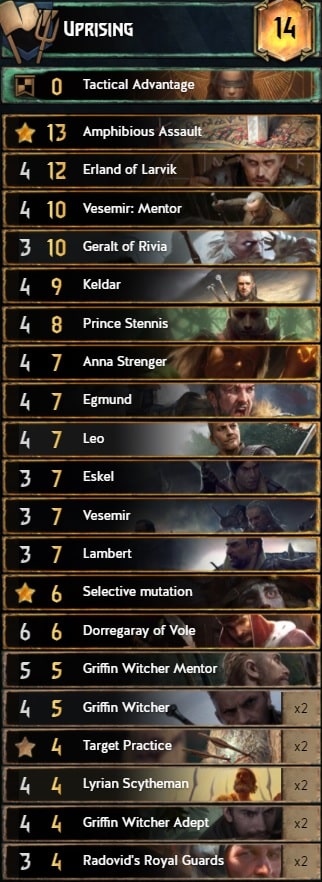
It’s time to finalize your bronze core and craft more pay-off cards. Remove 2x Tridam Infantry, Temerian Drummer and 2x Kerack Frigate, then craft 2x Griffin Witcher Adept, Target Practice, Selective Mutation and Leo.
With enough Witchers in your deck and more ways to generate Witcher tokens on the board, Vesemir: Mentor makes for a powerful addition. You can get rid of Nenneke and the remaining Temerian Drummer while crafting Vesemir: Mentor and Target Practice.
Crafting cost: 1830 scraps
[800 scraps] John Natalis
[800 scraps] Geralt: Quen
[230 scraps] Margarita, Boiling Oil
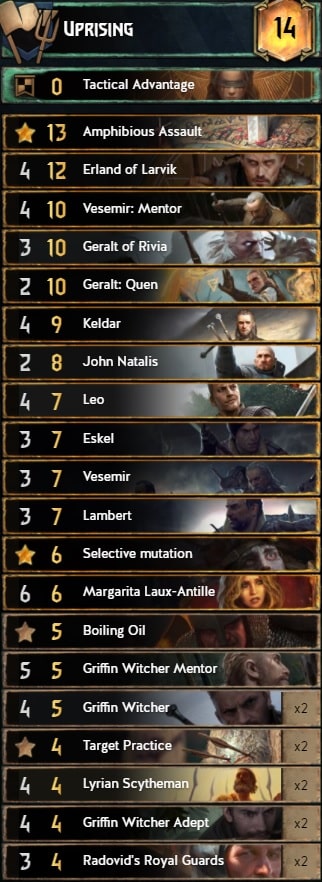
We’ve added a lot of power, now it’s time to add some consistency cards. Remove Dorregaray and Egmund for Natalis and Margarita. Finish off by cutting Prince Stennis and Anna Strenger for Geralt: Quen and a copy of Boiling Oil.
You should also craft the Crystal Skull stratagem - it offers a great synergy with Griffin Witcher.

The seafaring SK are known across the globe as savage warriors who grow stronger with every fight. Their fleet makes sure that the opposing units are damaged for their bloodthirsty pirates.
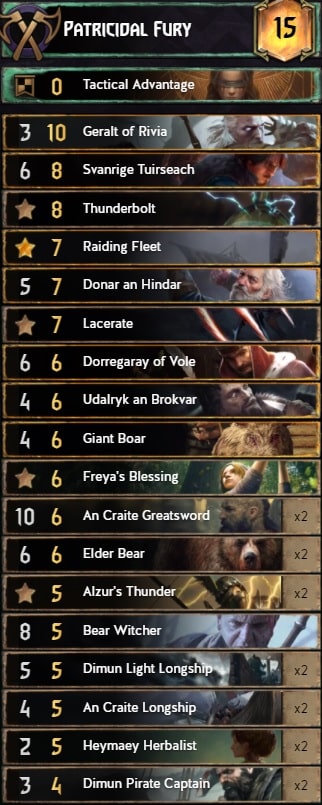
We’ll be working towards a Blaze of Glory deck focusing on warrior synergies. Built around cards like Harald an Craite to replay your bronze warriors and Blood Eagle to tutor them, it excels at shutting down any opposing engines.
Crafting cost: 440 scraps
[160 scraps] 2x Greatsword
[200 scraps] Raiding Fleet
[80 scraps] Bear Witcher
Although Greatswords are now capped at 10 strength, they’re still valuable. Your bronze ships help with getting the Greatswords rolling. In Round 3, you can use Patricidal Fury right after playing a Greatsword to put him out of removal range.
Crafting cost: 1080 scraps
[200 scraps] Herkja Drummond
[800 scraps] Svalblod Totem
[80 scraps] Bear Witcher
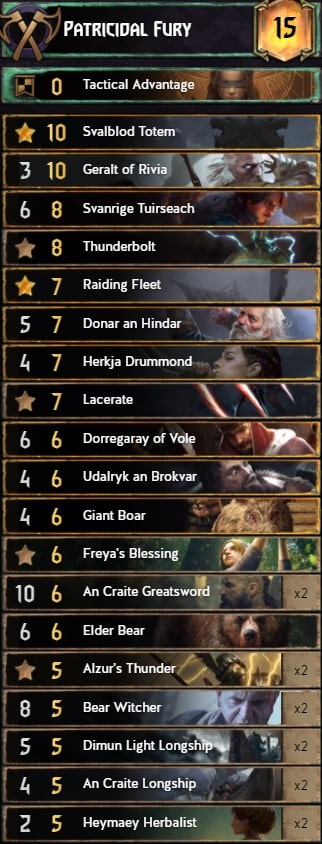
Herkja Drummond is a powerful engine, while Svalblod Totem offers some proactivity that can prove to be very useful when trying to bleed your opponent in Round 2.
Replace Elder Bear with Herkja, then get rid of 2x Pirate Captain while crafting Svalblod Totem and a copy of Bear Witcher.
Crafting cost: 1820 scraps
[800 scraps] Harald an Craite
[320 scraps] 2x An Craite Raiders, 2x Brokvar Hunter
[800 scraps] Haern Caduch
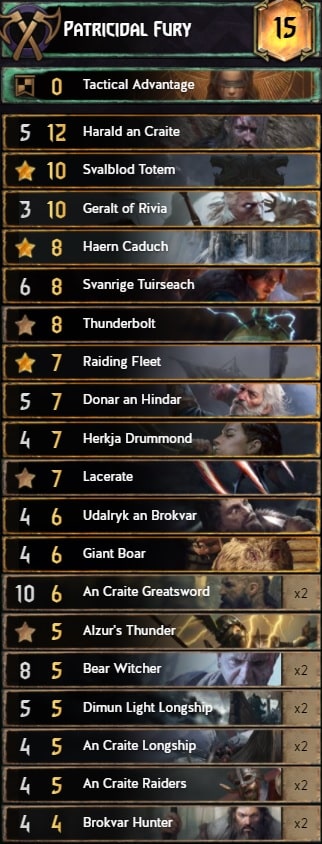
Harald an Craite can resurrect one of your bronze warriors. Haern Caduch offers a lot of value when you choose Bear Witcher or Bear Witcher Mentor. Be mindful of its placement and of its resilience, as the location can heal adjacent units (ideally Bear Witchers).
You can save 800 scraps on this upgrade if you buy the SK starter pack with Harald an Craite. Cut one Freya, Elder Bear, one Thunder and 2x Heymaey Herbalist, then craft Harald an Craite, 2x An Craite Raiders and 2x Brokvar Hunter.
Finally, replace Dorregaray with Haern Caduch. You can save another 800 scraps by unlocking Haern Caduch in your reward book (Arnaghad’s tree).
Crafting cost: 2060 scraps
[860 scraps] Blood Eagle, 2x Heymaey Protector
[1000 scraps] Eist Tuirseach, Jutta an Dimun
[200 scraps] Skjordal
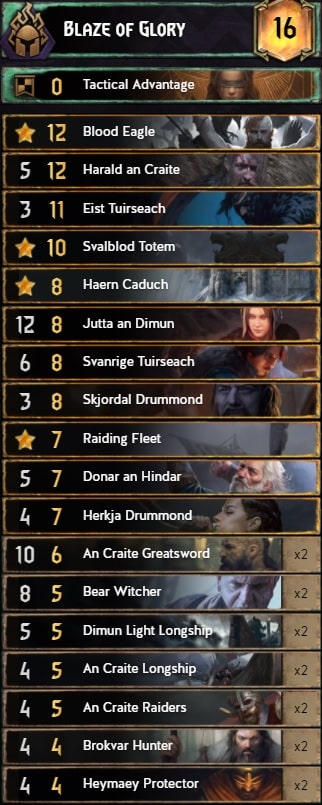
Blood Eagle improves your consistency while Eist Tuirseach and Jutta make for a powerful tempo play with Blaze of Glory. Getting rid of Neutral cards allows you to meet the Devotion condition for Harald an Craite, Eist and Skjordal Drummond.
Start off by replacing Thunderbolt, Lacerate and Thunder with Blood Eagle and 2x Heymaey Protector. You can then replace Geralt of Rivia and Giant Boar with Eist Tuirseach and Jutta while switching your leader ability to Blaze of Glory.
To finish the upgrade, get rid of Udalryk and craft Skjordal.
Crafting cost: 1950 scraps
[880 scraps] Vabjorn, War of Clans
[800 scraps] Morkvarg: Heart of Terror
[270 scraps] 2x Tuirseach Invader, Drummond Berserker, An Craite Marauder
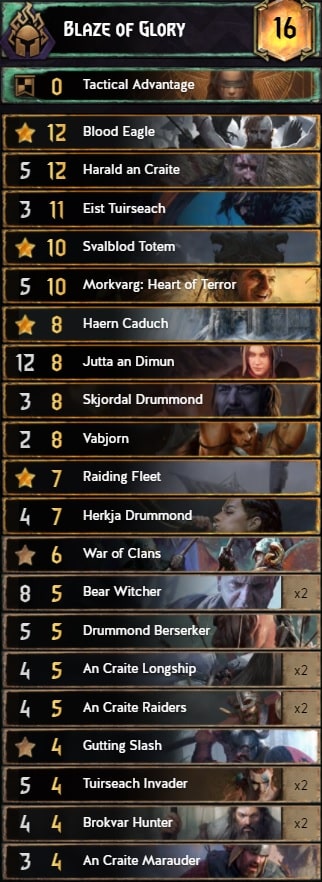
Vabjorn pulls Blood Eagle, Raiding Fleet and other Raid cards. Morkvarg: Heart of Terror deals with any boosted unit while setting up Bloodthirst.
Start by replacing Svanrige Tuirseach and 2x Dimun Light Longship with Vabjorn, War of Clans and a copy of Gutting Slash.
Finally, get rid of Donar an Hindar, 2x An Craite Greatsword and 2x Heymaey Protector while crafting Morkvarg: HoT, Drummond Berserker, 2x Tuirseach Invader and An Craite Marauder.
If you run into decks that row-stack, you can switch out Herkja for Gerd.

NG has no quarrel with fighting dirty. History is written by the victors and they can sweep all their unsavory tactics under the rug. When they’re not overwhelming the opponent with armies of soldiers, they’re using subterfuge to achieve their goals.
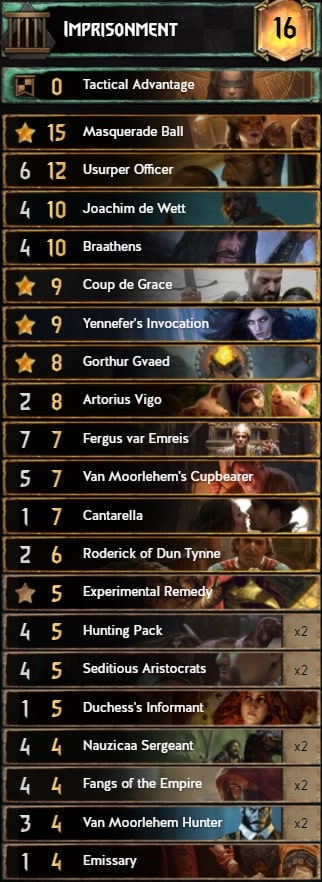
We’ll be working towards an Imprisonment deck with Masquerade Ball. Imprisonment allows you to lock the opposing engines while potentially setting up the perfect target for Coup de Grace.
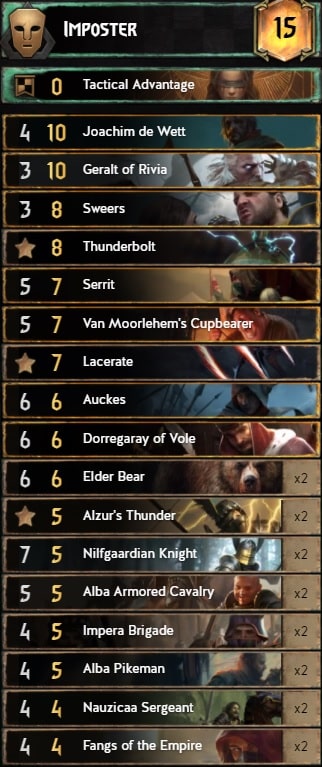
Crafting cost: 460 scraps
[200 scraps] Joachim de Wett
[260 scraps] 2x Fangs of the Empire, Van Moorlehem’s Cupbearer
Joachim is a great finisher, but be mindful of cards like Geralt of Rivia. Fangs of the Empire and Cupbearer form a Poison package which works well with Masquerade Ball.
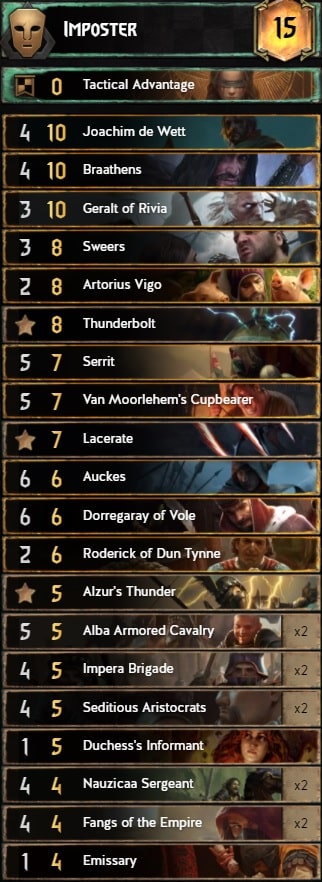
Crafting cost: 1440 scraps
[880 scraps] Braathens, Duchess’s Informant
[360 scraps] Artorius Vigo, 2x Seditious Aristocrats
[200 scraps] Roderick
This upgrade might seem a bit too expensive as your first one, so let’s take it one step at a time.
To kick things off, replace 2x Alba Pikeman and Elder Bear with Braathens, Duchess’s Informant and Emissary. You can then get rid of Alzur’s Thunder and 2x Nilfgaardian Knight while crafting Artorius Vigo and 2x Seditious Aristocrats.
With more gold cards in the deck, Roderick of Dun Tynne becomes a good inclusion to increase your consistency. Remove the other Elder Bear in order to accommodate him.
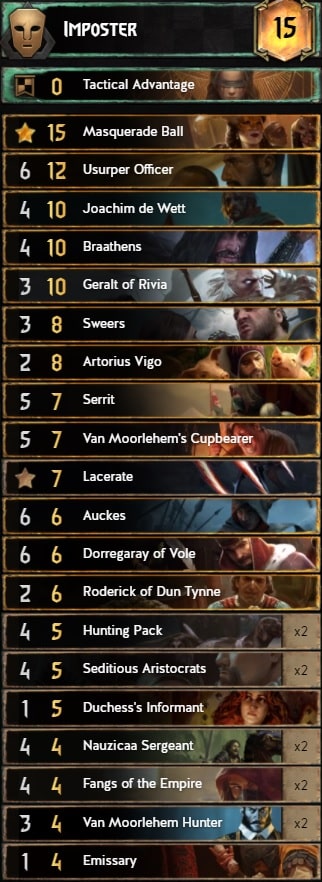
Crafting cost: 1920 scraps
[960 scraps] Masquerade Ball, 2x Van Moorlehem Hunter
[800 scraps] Usurper Officer
[160 scraps] 2x Hunting Pack
Masquerade Ball is an extremely powerful Scenario, allowing you to murder an opposing unit while synergizing with Assimilate engines like Braathens and Cupbearer.
Usurper Officer is a great proactive play that can come in handy when defending the bleed or in a short Round 3. You can save 800 scraps on Usurper Officer if you buy the NG starter pack.
Replace Thunder and 2x Impera Brigade with Masquerade Ball and 2x Van Moorlehem Hunter. Then, upgrade Thunderbolt to Usurper and replace 2x Armored Cavalry with 2x Hunting Pack.
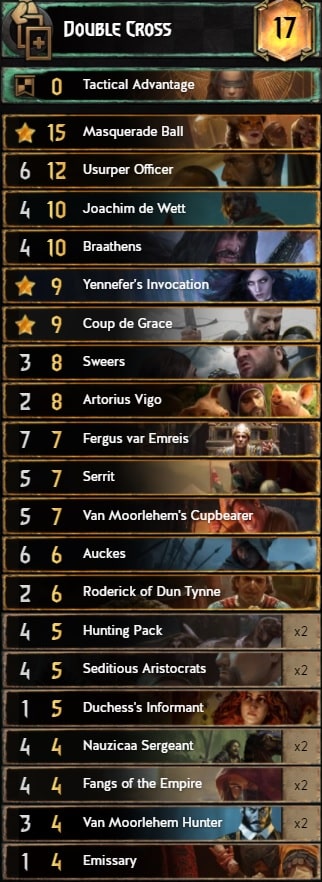
Crafting cost: 1800 scraps
[800 scraps] Coup de Grace
[800 scraps] Yennefer’s Invocation
[200 scraps] Fergus var Emreis
You can switch your leader ability to Double Cross while upgrading Lacerate to Coup de Grace. For 1000 scraps, proceed to replace Geralt of Rivia and Dorregaray with Yennefer’s Invocation and Fergus var Emreis.
Fulfilling the Devotion condition means that Usurper will have the Aristocrat tag in Round 3 and can thus be used to proc Masquerade Ball.
Crafting cost: 1080 scraps
[800 scraps] Gorthur Gvaed
[280 scraps] Cantarella, Experimental Remedy
Gorthur Gvaed gives you the freedom of playing Joachim de Wett in Round 1. In future rounds, you can put him back at the top of the opponent’s deck using the location and then play him again with Cantarella.
This time, switch your leader ability to Imprisonment, then replace Sweers, Serrit and Auckes with Gorthur Gvaed, Cantarella and Experimental Remedy.
You can save 800 scraps by unlocking Gorthur Gvaed in your reward book (Ivar Evil-Eye’s tree).